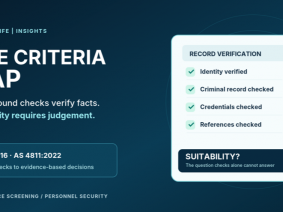
A background check reports what is held about a person. A suitability assessment forms a judgement about them. Under AS 4811:2022, they are not the same step.
There’s been some good material circulating that summarises the mandatory statements in AS 4811:2022. Nineteen clauses, cleanly extracted, worth reading.
I want to add the part that a shall-list can’t show you, because I’ve spent a decade on the other side of this — as a former AGSVA panel member, and now running suitability assessments for DISP members and critical infrastructure operators.
Read the nineteen as a set and ask the practitioner’s question: what would an organisation actually have to do to satisfy all of them? Write a policy. Document a process. Take consent, a privacy statement, a statutory declaration. Establish evaluation criteria. Use reliable sources. Review access privileges when risk changes.
Every one of those is procedural. Not one of them requires you to assess a person.
An organisation that implemented all nineteen, literally and completely, would hold a fully documented screening programme that never screens anybody.
That isn’t a gap in the Standard. It’s what happens when you read a Standard by searching it for the word “shall.”
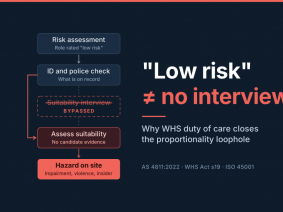
Clause 2.8.2 requires a clear sequence of actions for conducting checks — and the Standard’s own worked example is “check eligibility first before conducting suitability checks.” Figure 1 sets that sequence out: conduct suitability interview, then assess against eligibility criteria, then assess against suitability criteria.
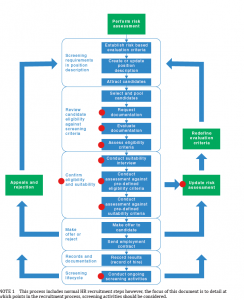
The interview sits upstream of both assessments. It’s an input, not an escalation you reach for when something looks wrong.
So what is the organisation assessing against?
AS 4811 doesn’t say. It leaves the criteria to you, by design. That’s the part people miss, and it’s the part that matters.
Because two Commonwealth bodies have already answered it — from opposite directions, and identically.
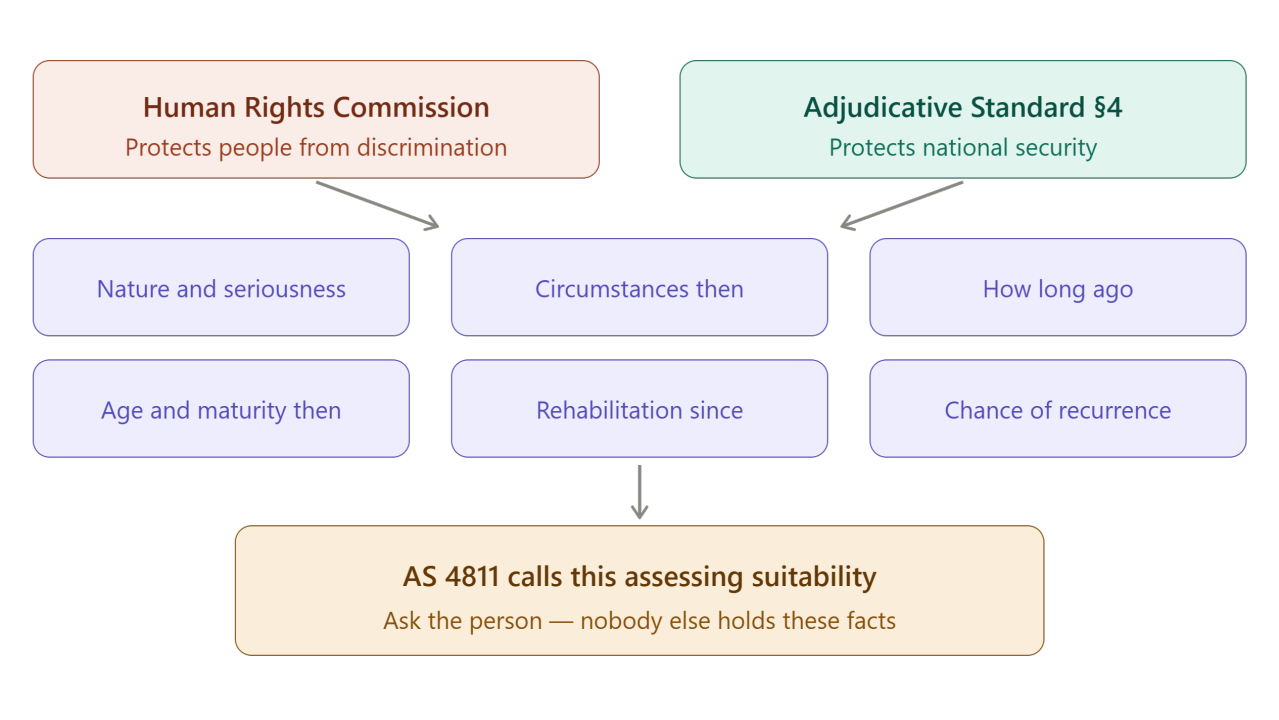
The Australian Government Personnel Security Adjudicative Standard requires an assessor weighing conduct to consider its nature, extent and seriousness. The circumstances surrounding it, including the degree of willing or knowledgeable participation. Frequency and currency. The person’s age and maturity at the time. Presence or absence of rehabilitation. Motivation. Potential for pressure, coercion, exploitation or duress. Likelihood of recurrence.
The Australian Human Rights Commission, approaching criminal record discrimination from the complete opposite direction, requires an employer to assess against the inherent requirements of the actual job: the nature and circumstances of the offence, how long ago, how old the person was, whether it forms a pattern, what has changed since.
One body protecting national security. One protecting people from discrimination. Same list.
A quick note on scope, because it matters: the Adjudicative Standard binds Authorised Vetting Agencies, not DISP members. I cite it because it is the clearest published statement of what a suitability assessment has to weigh, and because it’s the benchmark your sponsored people will actually be measured against.
Now the practical problem.
A criminal history check is a record of detected conduct. Motivation is not conduct. Maturity is a judgement, not a data field. Susceptibility to coercion is, by definition, the thing a person would prefer nobody knew. These were never in scope for a record to contain, and no amount of database integration will produce them.
And here is the part that gets least attention.
Go through the Adjudicative Standard’s mitigating conditions. The person was unaware of the unlawful aims and severed ties on learning of them. Their involvement was only with the lawful aspects. It was short-lived and attributable to curiosity. They were pressured at the time and those pressures are gone. They made prompt, good-faith efforts to correct an omission before being confronted with it.
Almost every mitigating condition in that document is held by one person. The candidate.
Records surface what disqualifies. Only the person surfaces what mitigates. And the Standard directs that any doubt be resolved in favour of the national interest — doubt resolves against the individual.
So a screening model with no elicitation is not neutral. It is fully equipped to find against someone and has no mechanism at all to find for them.
That is why I insist on the structured 1:1. Not because it’s thorough. Because it’s the only point in the process where a person gets to be heard.
Criminal record was 37% of grounds raised under the Australian Human Rights Commission Act in 2019–20 — the largest single ground of discrimination complaint under that Act. Those complaints are not generated by organisations that assess people too carefully. They’re generated by the records-only model: check in, decision out, nobody asked. No adjudication.
The Commonwealth reached the same conclusion, in terms that leave little room. Refusal or failure without reasonable cause to cooperate with the clearance process — expressly including meeting with a vetting analyst for a security interview — will normally result in denial or revocation.
Declining the 1:1 is treated as normally disqualifying. It is not one methodology among several.
Use the shall-list. It’s a good scaffold. Just don’t stop there — the criteria you need are in a different document to the one everyone’s summarising.
Ps. A note on where I’m standing
Cleard Life was independently reviewed against AS 4811:2022 in 2026 — all 19 mandatory clauses, and all 73 recommended ones. The reviewer was the Project Lead for the AS 4811:2022 Standard Assurance Project.
Worth being precise about what that is and isn’t. AS 4811 is not a certifiable standard. There is no certification body, no accredited scheme, no badge to buy. Independent review against the full clause set is the highest recognition available, which also means the bar is open to anyone willing to be looked at properly.
That’s the position this piece is written from, and you should weigh it accordingly. I sell suitability assessments. I’ve argued here that the assessment is unavoidable, which is convenient for me. The argument stands or falls on the documents, not on who’s making it — every instrument I’ve cited is public, and I’d encourage anyone to go and read the clauses themselves rather than take my summary of them.
The detail on the review is here: cleard.life/as4811