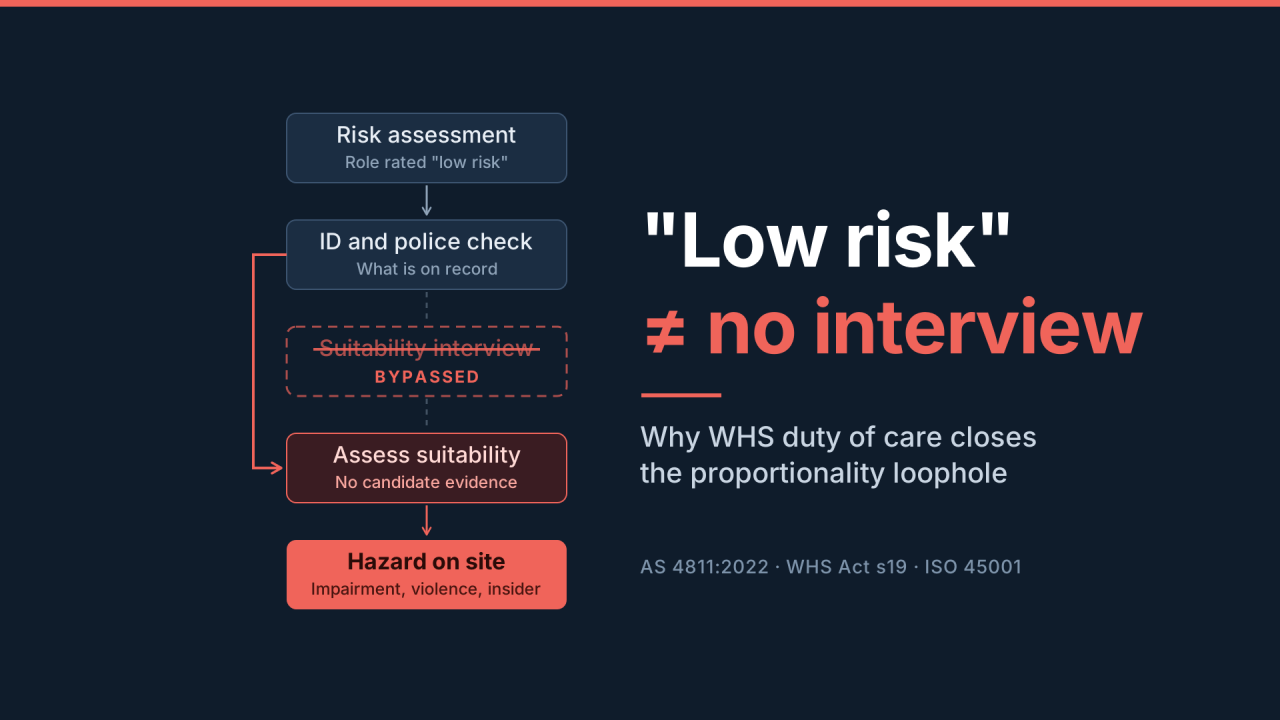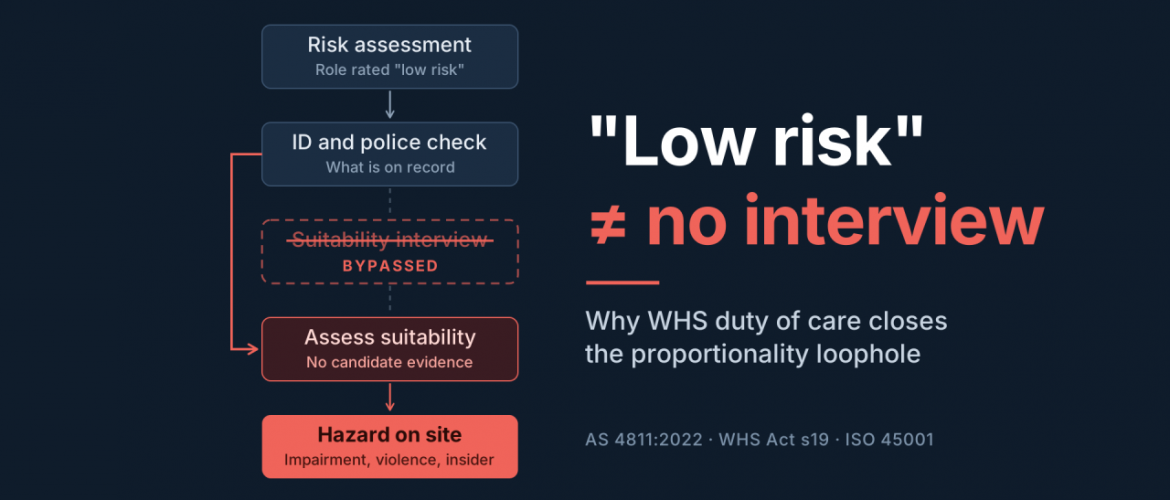
There’s a reading of workforce screening gaining ground in Australia. It goes like this: if a role is low risk, proportionality lets you skip the one-on-one suitability interview. An ID check, a police check, a couple of references, and you’re done.
It sounds efficient. It doesn’t survive first contact with the Work Health and Safety Act.
The duty doesn’t scale down to zero
Under section 19 of the model WHS Act, every employer has a primary duty of care. They must ensure, so far as is reasonably practicable, the physical and psychological health and safety of workers and others at the workplace.
ISO 45001, together with ISO 45003 on psychosocial risk, treats human behaviour, impairment and interpersonal conduct as workplace hazards.
There is no “low risk role” exemption from that duty. A receptionist, a cleaner, a junior clerk or a warehouse packer may have no access to sensitive data. But they share corridors, car parks, vehicles, lunchrooms and group chats with everyone else.
Proportionality scales depth, not existence
AS 4811:2022 builds on the risk management principles of AS ISO 31000:2018. Proportionality is real, but it governs the depth, criteria and frequency of assessment. It doesn’t decide whether assessment happens at all.
In practice, an entry-level role might warrant a 15–20 minute structured interview, and an executive role a deep dive. Both get a conversation.
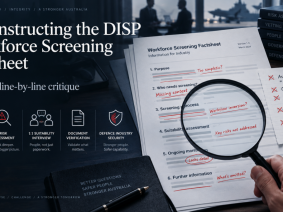
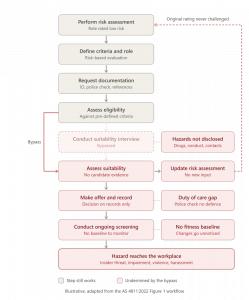
Don’t take my word for it. The Standard’s own screening workflow (Figure 1) and clause 2.8.2 place the suitability interview upstream of both the eligibility and suitability assessments. It is an input, not an escalation step.
Why a police check fails the WHS test
A national police check shows what a court has recorded. It doesn’t show what is happening now.
Workplace drug testing data from SafeWork Laboratories (2017) found 1.9% of workers in safety-sensitive industries nationally tested positive for methamphetamine. In South Australia the figure was 2.2%. That’s roughly 1 in 50 nationally and about 1 in 45 in SA.
Cannabis tells a similar story. A recent nationally representative study in Drug and Alcohol Dependence (Di Censo, Thompson and Bowden, 2026) found 5% of employed Australians report weekly illicit cannabis use, about 1 in 20. A further 2.2% were at risk of cannabis-related harm.
Use was highest in construction and hospitality. Hospitality is exactly the kind of entry-level, customer-facing work often labelled “low risk”. Weekly use was linked to 2.8 extra days absent a year, and 6.9 days for those at risk of harm.
None of those workers would show up on a police check unless they’d been charged and convicted.
Some employers will say they’re covered because they drug test. Many are, in mining, construction and transport, where testing is built into the safety system. But the roles most often labelled “low risk” usually have no testing at all. Office, retail, cleaning and hospitality all fall into that group, and hospitality has some of the highest rates of cannabis use.
If you don’t drug test, the suitability interview is the only pre-engagement control you have for impairment. Without it, nothing in your process asks the question.
Even where testing exists, it has limits:
- It’s a snapshot. A pre-employment test is scheduled, so a candidate knows when it’s coming and can plan around it.
- It detects a substance, not a pattern. A positive or negative result doesn’t tell you about frequency, dependence, or how use affects someone at work.
- It only covers drugs. It won’t surface gambling harm, coercion, violent conduct or disregard for safety rules, the other factor areas that create WHS hazards.
Testing and the interview do different jobs. A test checks for a substance on the day. An interview explores behaviour, context and disclosure, and it sets the baseline that ongoing screening, including any testing, is measured against.
Seven risk factor areas, seven WHS hazards
The Australian Government’s personnel security adjudicative factors, referenced in AS 4811:2022’s bibliography, assess suitability across seven areas. Each one maps to a real WHS hazard, even in an entry-level role:
- External loyalties, influences and associations. A cleaner linked to an organised crime group may be pressured to share rosters or allow after-hours access, exposing colleagues to intimidation and extortion.
- Personal relationships and conduct. Domestic violence that follows a worker onto the premises, or harassment and bullying of colleagues, creates both physical and psychosocial hazards.
- Financial considerations. Severe debt or gambling harm brings sleep loss, distraction and acute stress. The results include errors with chemicals, skipped safety checks, conflict or theft.
- Alcohol and drug use. Impairment in a warehouse, kitchen or mailroom leads to collisions, unsafe manual handling and unpredictable behaviour.
- Criminal history and conduct. Violent incidents that ended in diversion, a spent conviction or no charge at all leave the police check clean. Only a conversation tests conflict history and how someone handles frustration.
- Security attitudes and violations. A worker who props open fire doors, bypasses machine guards or ignores evacuation procedures puts every occupant at risk.
- Mental health and well being. The aim isn’t to exclude people. It’s to understand fitness for work and any support needed, so psychosocial risks are managed early. Done properly, this protects the worker as much as the workplace.
A caution: the interview has to be job-related, consent-based, privacy-compliant and consistent with anti-discrimination law (also referenced in AS 4811:2022’s bibliography). A well-designed structured interview is how you meet those obligations. Skipping it doesn’t avoid them.
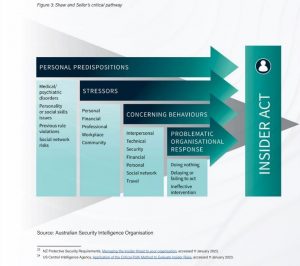
It’s also back by research:
The bottom line
A police check tells you whether someone was caught in the past. A suitability interview tells you who they are today.
It’s the control that surfaces unrecorded hazards such as impairment, gambling harm, violence and coercion. It turns “we ticked the boxes” into a defensible WHS position.
Proportionality decides how deep that conversation goes, not whether it happens.
How is your organisation applying proportionality to entry-level roles?
Sources
- Di Censo, G., Thompson, K. & Bowden, J. (2026). Illicit cannabis use among workers in Australia: A nationally representative cross-sectional analysis of prevalence, determinants, and associated absenteeism. Drug and Alcohol Dependence. https://www.sciencedirect.com/science/article/pii/S0376871626000384
- SA Business Chamber, The Ice Age (SafeWork Laboratories data, 2017). https://sabusinesschamber.com.au/about-business-sa/media-centre/the-ice-age-the-drug-epidemic-hitting-the-sa-workforce
- Standards Australia, AS 4811:2022 Workforce screening; AS ISO 31000:2018 Risk management.
- Model Work Health and Safety Act, s19.