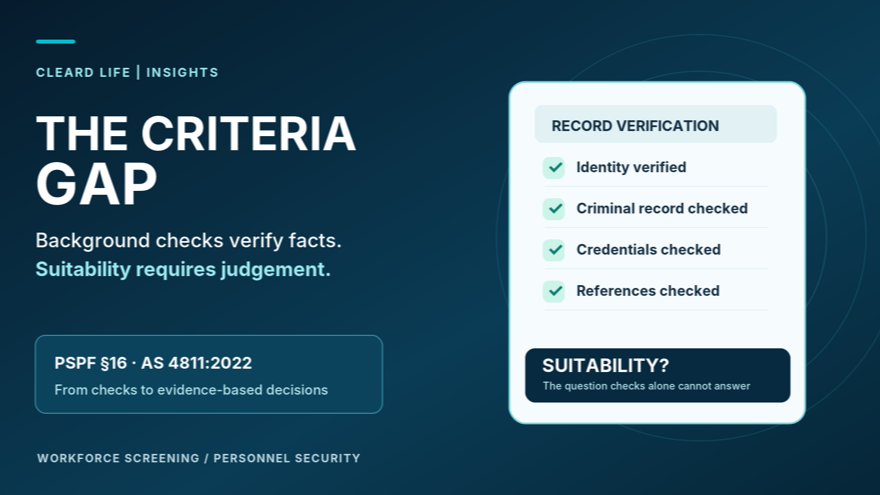
An Australian workforce-screening perspective on PSPF Section 16, AS 4811:2022 and the value of structured one-to-one suitability interviews.
A candidate passes their identity check, police history check, qualification verification and reference checks. Does that mean they are suitable for a position involving sensitive information, vulnerable people or critical infrastructure?
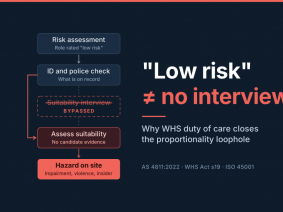
Not necessarily. Those checks establish important facts, but they do not automatically tell an organisation how to evaluate the facts, whether there are current vulnerabilities, or what mitigating circumstances ought to be considered.
This is the criteria gap in workforce screening: collecting evidence without a sufficiently clear, consistent basis for judging its relevance to a particular role.
Checks are evidence. They are not a decision framework.
Consider an applicant with a ten-year-old conviction. A police check may reveal it, but cannot, on its own, answer whether the behaviour is relevant to the role today.
What happened? How old was the candidate? Was it an isolated incident? Have they rehabilitated? What safeguards exist?
The reverse problem also matters. A clean record cannot rule out all present-day risk. Financial pressure, undisclosed conflicts of interest, unrecorded workplace misconduct or attempts at manipulation may not appear in routine database searches.
Equally, the existence of debt, a past offence or a disclosed personal circumstance must never be treated as automatic evidence of unsuitability.
A defensible approach needs both reliable checks and a method for evaluating what they mean.
PSPF Section 16: pre-employment screening is more than a tick-box exercise
The Australian Government’s Protective Security Policy Framework (PSPF) Release 2026, Section 16 — Pre-Employment Eligibility, requires pre-employment screening for personnel working in or for Australian Government entities, including relevant contractors and personnel who do not require a security clearance.
Section 16.1 explains the role of screening in providing assurance that people are suitable to access government resources. It also allows entity-specific screening appropriate to the organisation’s risks.

This is distinct from security-clearance vetting. Pre-employment screening and an AGSVA security clearance are not the same decision or the same process.
For roles requiring a clearance, the employment-screening decision is an important upstream responsibility, not something to assume the vetting agency will resolve on the employer’s behalf.
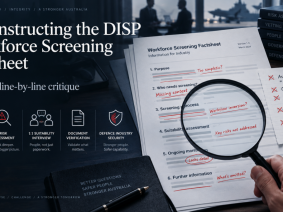
For Defence suppliers, the separate Defence Security Principles Framework (DSPF) Principle 16 and the Defence Industry Security Program (DISP) connect personnel-security obligations to AS 4811:2022 — Workforce screening.
Defence explicitly states that employment screening applies to cleared and non-cleared personnel within its relevant scope.
How do you assess the whole person, fairly?
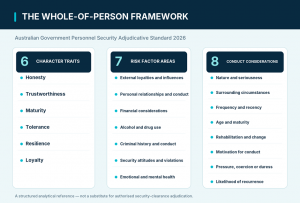
The Australian Government Personnel Security Adjudicative Standard 2026 provides a rigorous example of structured professional judgement for security-clearance decisions.
It considers six character traits: honesty, trustworthiness, maturity, tolerance, resilience and loyalty.
The assessment considers evidence across seven risk factor areas:
- External loyalties, influences and associations
- Personal relationships and conduct
- Financial considerations
- Alcohol and drug use
- Criminal history and conduct
- Security attitudes and violations
- Emotional and mental health issues
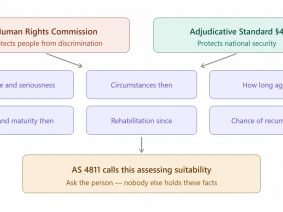
Where conduct of concern is identified, the Standard specifies eight considerations for weighing its relevance:
- Nature, extent and seriousness of the conduct
- Circumstances, including the degree of willing or knowledgeable participation
- Frequency and currency of the conduct
- Age and maturity at the time
- Rehabilitation and other relevant behavioural changes
- Motivation for the conduct
- Potential for pressure, coercion, exploitation or duress
- Likelihood of continuation or recurrence
The important lesson is not to label every candidate with a numerical risk score.
It is to ensure that findings are assessed against transparent criteria, within the context of the role, with reasons, relevant mitigating evidence and appropriate human oversight.
Government security-clearance standards can inform a civilian screening methodology, but adopting their analytical principles does not confer authority to issue an Australian Government security clearance.
The elicitation gap: the record cannot tell the candidate’s whole story
There is an inherent asymmetry in records-only screening.
A database may identify an adverse event, but it rarely includes the full account of what happened, the candidate’s response, or what has changed since.
That is where a structured one-to-one suitability interview adds value.
It creates an opportunity to explore relevant circumstances, test consistency, identify omissions, understand possible vulnerabilities and document mitigation.
Just as importantly, it allows the candidate to explain information that could otherwise be misinterpreted.
The Australian Human Rights Commission’s On the Record guidelines similarly encourage employers to consider the seriousness and relevance of criminal history, the circumstances and timing, the applicant’s age, subsequent behaviour and the inherent requirements of the role.
The AHRC guidelines and the Adjudicative Standard are not identical legal tests, but they share a vital principle: context matters.
An effective interview is not a licence for indiscriminate questioning. Questions must be relevant, proportionate, respectful and supported by an appropriate privacy and consent framework.
Mental health conditions or protected personal attributes must not be treated as proxies for misconduct or security risk.
The right sequence: organisation, role, then candidate
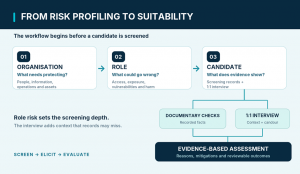
Under an ISO 31000-style risk-management approach, workforce screening should begin before the candidate arrives.
First, the organisation identifies the people, information and operations it needs to protect.
Second, it assesses the particular role: access, authority, exposure, opportunities for harm and likely consequences.
Third, it gathers and evaluates candidate evidence against that role-specific profile.
This order avoids two common errors: performing the same expensive checks for every position regardless of risk, and using a minimalist screening package where a role exposes critical assets or vulnerable people.
At Cleard Life, we regard a structured 1:1 suitability interview as a primary evidence-gathering step, not merely something to trigger after a police or credit check reveals a problem.
The intensity of the interview and the scope of supporting checks can be scaled to the role. A risk-based method should not become a reason to ignore human context altogether.
Why this matters for Defence, critical infrastructure and employers
For DISP members, Defence identifies AS 4811:2022 as the relevant Australian workforce-screening standard, covering personnel within the applicable personnel-security requirements.
For critical infrastructure, the Security of Critical Infrastructure Act 2018 and related Critical Infrastructure Risk Management Program Rules require relevant responsible entities to address material personnel hazards.
The applicable requirements depend on asset class and whether baseline or enhanced CIRMP obligations apply. The Rules distinguish rule 9 (personnel hazards) from rule 9A (enhanced personnel hazards).
For other employers, the same underlying discipline is valuable: document why a check was selected, identify what a finding means for the actual job, hear relevant context, decide proportionately and retain an appropriate audit trail.
But no screening model, interview or standard automatically guarantees compliance with work health and safety, privacy, discrimination or sector-specific laws.
Organisations remain responsible for applying the rules that govern their workforce and for reviewing decisions when circumstances change.
A better definition of screening maturity
An organisation should be able to answer five questions about every material suitability decision:
- Why was this role screened at this level?
- What reliable evidence was collected, and what remains uncertain?
- How were relevant adverse findings and mitigating circumstances evaluated?
- Who made or reviewed the decision, and using which criteria?
- What will trigger reassessment if circumstances change?
A police check can help answer part of the second question. It cannot answer all five.
The next step in workforce screening is not simply more database searches. It is better evaluation of evidence, supported by structured interviews, procedural fairness and accountable human judgement.
Discuss your workforce screening program
Cleard Life helps organisations design and deliver workforce screening and suitability assessments, including for Defence industry and risk-sensitive environments.
Key references
- Australian Government PSPF Release 2026 — Section 16
- Australian Government Personnel Security Adjudicative Standard 2026
- Defence Industry Security Program — eligibility and suitability
- Australian Human Rights Commission — On the Record
- Critical Infrastructure Risk Management Program regulatory obligations
- OAIC — Australian Privacy Principle 3 guidance
This article provides general personnel-security and workforce-screening information; it is not legal advice or an assertion that civilian screening is equivalent to Australian Government security-clearance vetting.