Why a police check is not a suitability assessment—and why structured candidate interviews must be a foundational part of workforce screening.
In an era of insider threats, increasingly sophisticated résumé fraud and expanding personnel security obligations, Australian organisations are under pressure to demonstrate that their employees and contractors are trustworthy.
Yet many employers continue to rely on a familiar formula: verify identity, obtain a National Police History Check, review employment references and declare the candidate vetted.
But has the organisation actually assessed the candidate’s suitability—or has it simply checked a collection of records?
This distinction is fundamental to AS 4811:2022 Workforce Screening and the Australian Government’s Protective Security Policy Framework (PSPF).
A background check establishes what can be independently verified about an individual. A suitability assessment evaluates whether that individual presents an acceptable level of risk in the context of their intended role, responsibilities and access.
The two are not interchangeable.
While AS 4811:2022 does not contain an isolated, universal shall statement requiring the organisation to conduct a 1:1 suitability interview, its process architecture makes direct candidate engagement a central component of effective screening.
For organisations responsible for sensitive information, critical infrastructure, Defence industry personnel or other positions of trust, the structured 1:1 interview is far more than an administrative formality.
It is the mechanism through which background information becomes an informed, contextual and defensible suitability assessment.
1. AS 4811:2022: The Interview Belongs Upstream of the Suitability Decision
AS 4811:2022 fundamentally changes how organisations should approach workforce screening.
Rather than treating screening as a collection of one-off checks, the Standard establishes a structured process in which eligibility, suitability and personnel risk are assessed within an ongoing risk management framework.
This approach aligns with the principles of AS ISO 31000:2018 Risk Management.
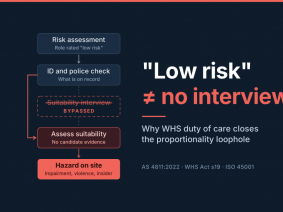
Importantly, Clause 2.8.2 addresses the sequencing of screening activities, while Figure 1 identifies the suitability interview within the process for confirming eligibility and suitability.
The interview appears upstream of the assessment decision.
That positioning matters.
A candidate’s responses may identify issues requiring verification, explain discrepancies in available records, reveal relevant mitigating circumstances or establish that no further investigation is warranted.
The information gathered through the interview therefore becomes an input to the subsequent risk assessment.
The interview is not simply a remedial action triggered when a database check produces an adverse result.
An organisation that conducts interviews only after discovering a criminal conviction, unexplained debt or suspicious reference is limiting its assessment to risks already visible through other channels.
It may never examine risks for which no existing record is available.
AS 4811 allows organisations to establish screening processes appropriate to their circumstances. Nevertheless, where a meaningful assessment of individual character, conduct and vulnerability is required, omitting direct candidate engagement creates a significant evidentiary gap.
The operational question becomes:
How can an organisation make a defensible whole-of-person suitability decision without first obtaining the person’s own account of their conduct and circumstances?
2. The Clean Police Check Fallacy: One Check Cannot Assess Seven Risk Factor Areas
A National Police History Check is an important screening control.
But a clear result does not establish that an individual is honest, trustworthy, reliable or suitable for a position of trust.
The Australian Government’s Personnel Security Adjudicative Standard 2026 identifies seven risk factor areas relevant to security clearance suitability:
- External loyalties, influences and associations — potential conflicts of interest, foreign influence and vulnerability to coercion.
- Personal relationships and conduct — behaviour, judgement, honesty and reliability.
- Financial considerations — financial pressures, irresponsible financial conduct and susceptibility to exploitation.
- Alcohol and drug use — relevant patterns of use and their implications for security responsibilities.
- Criminal history and conduct — relevant criminal behaviour and the surrounding circumstances.
- Security attitudes and violations — compliance with security obligations and protection of sensitive information.
- Emotional and mental health issues — circumstances that may materially affect security responsibilities, assessed individually and without assumptions based on diagnosis.
A conventional police history check principally contributes evidence to one of these seven areas.
It does not establish the remaining six.
This does not mean the police check covers precisely one-seventh of an individual’s risk. These areas overlap and their relevance varies according to the position. Rather, it demonstrates the fundamental limitations of relying on any single information source.
Consider the types of concerns that may never appear on a police record:
- Materially falsified employment qualifications or experience.
- Undisclosed conflicts of interest or competing obligations.
- Significant financial pressures that create an identifiable vulnerability.
- Serious workplace misconduct that did not result in criminal proceedings.
- Deliberate security policy violations.
- Relevant personal circumstances that have changed since an earlier screening decision.
These matters may be relevant to an organisation’s personnel security risk assessment even where the candidate has never been convicted of an offence.
The 2026 Adjudicative Standard also identifies six character traits: honesty, trustworthiness, maturity, tolerance, resilience and loyalty.
A clear criminal history check cannot, by itself, establish those qualities.
The Adjudicative Standard applies directly to authorised security vetting arrangements. It is not automatically a mandatory seven-factor assessment framework for every private-sector employment decision. Nevertheless, it provides a useful, established reference for designing comprehensive and proportionate suitability assessments.
3. The Evidence: Recruitment Fraud Is Real, and Static Checks Have Limits
The NSW Independent Commission Against Corruption (ICAC) has documented the prevalence of employment application fraud.
In its 2018 report, Strengthening Employment Screening Practices in the NSW Public Sector, ICAC cited research indicating that 20% to 30% of job applications contained some form of false information.
The discrepancies ranged from incorrect employment histories and qualifications to misleading references and other material omissions.
Not every discrepancy constitutes deliberate deception. However, the finding illustrates why relying solely on the information presented in a candidate’s application can create exposure.
A structured 1:1 interview provides an opportunity to explore inconsistencies, request clarification and identify matters requiring independent verification.
It can also encourage voluntary disclosure of concerns that would otherwise remain unidentified.
Creating the conditions for candour
Effective suitability interviews are not interrogations.
They establish a clear framework in which candidates understand:
- The purpose and scope of the assessment.
- Their obligation to provide truthful, complete and accurate information relevant to the assessment.
- How their information will be used, protected and disclosed.
- Their opportunity to explain circumstances and correct inaccuracies.
- The potential consequences of deliberate concealment or materially misleading statements.
A well-designed interview uses consistent topics, relevant follow-up questions and a confidential environment to encourage candour.
Candidates may disclose historical misconduct, financial difficulties, workplace disputes or other relevant circumstances because they understand that the objective is to assess the complete situation—not automatically reject anyone who has experienced difficulty.
The presence of adverse information does not necessarily establish unsuitability. How a person responds, what has changed and whether the underlying risk remains material are equally important.
An interview cannot guarantee truthful answers or independently prove an individual’s integrity. It must be supported by appropriate verification, corroboration and professional judgement.
Nevertheless, without direct engagement, important information may never enter the assessment process.
4. Procedural Fairness: The Candidate Holds Information That Records Cannot Provide
There is another important limitation of records-only screening.
Records can identify adverse events, but often provide little information about mitigating circumstances.
Consider two candidates with similar criminal histories.
One may have engaged in repeated dishonest conduct that continues to present a material risk.
The other may have committed an isolated offence many years earlier, accepted responsibility, completed rehabilitation and demonstrated sustained positive conduct.
A database check may show comparable recorded offences.
Their current suitability could be very different.
Eight considerations that make the difference
The Australian Government’s 2026 Personnel Security Adjudicative Standard directs security vetting analysts and delegates to consider eight matters when evaluating conduct:
- The nature, extent and seriousness of the conduct.
- The surrounding circumstances, including willing or knowledgeable participation.
- The frequency and currency of the conduct.
- The individual’s age and maturity at the time.
- Evidence of rehabilitation and other relevant behavioural change.
- The motivation for the conduct.
- Potential for pressure, coercion, exploitation or duress.
- The likelihood of continuation or recurrence.
These are not merely questions about what happened.
They require an understanding of why it happened, what has changed and what the conduct means today.
In many cases, the candidate is the primary source of this context.
The Australian Human Rights Commission perspective
The Australian Human Rights Commission’s guidance on criminal record discrimination reinforces the importance of individualised assessment.
Employers considering adverse criminal history should examine its relevance to the inherent requirements of the particular position, rather than automatically excluding candidates because a record exists.
The Commission’s 2019–20 complaints statistics identified criminal record discrimination as 37% of grounds raised under the Australian Human Rights Commission Act during that reporting period.
This is a historical, specifically defined statistic—not 37% of all discrimination complaints or a finding that records-only screening caused those complaints.
Nevertheless, it reinforces the importance of fair recruitment processes.
A structured suitability interview gives candidates a meaningful opportunity to explain the circumstances of adverse information, identify mitigating factors and correct factual errors before a decision is made.
The AHRC guidelines are not themselves legally binding, and an interview does not guarantee compliance with discrimination law. However, direct candidate engagement provides evidence that the organisation has undertaken a more individualised and considered assessment.
Procedural fairness and effective security screening should reinforce each other—not operate as competing objectives.
5. PSPF 16, DISP and Critical Infrastructure: Why the Interview Matters Operationally
For organisations operating within government and regulated security environments, the need for defensible suitability assessments becomes particularly significant.
Australian Government: PSPF Section 16
The PSPF Release 2026, Section 16 — Pre-Employment Eligibility, requires Australian Government entities to undertake pre-employment screening for personnel who access government resources.
This applies to security-cleared and non-security-cleared personnel, including relevant contractors.
Under Requirement 0120, entities must obtain assurance of each person’s suitability to access Australian Government resources.

The distinction is important: eligibility to work is not the same as suitability to access sensitive government resources.
A structured suitability interview can provide relevant evidence of personal conduct, vulnerabilities and integrity that complements formal eligibility and background checks.
PSPF Section 16 does not establish a universal requirement for a 1:1 interview for every role. Organisations must select controls appropriate to their obligations and risk environment.
Defence Industry Security Program: AS 4811 Alignment
The Department of Defence expressly identifies AS 4811:2022 as a workforce screening standard that DISP members need to meet.
Personnel security responsibilities extend beyond simply identifying which employees require an AGSVA security clearance.
They also encompass screening and managing personnel who may access government information, Defence assets and other protected resources.
For DISP members, a documented 1:1 interview supported by a suitability risk assessment creates a stronger evidentiary foundation for demonstrating that personnel screening has meaningfully examined relevant risks.
It also establishes a useful baseline for identifying and assessing subsequent changes of circumstance.
Importantly, an employer-level suitability assessment is distinct from a formal national security clearance determination, which remains the responsibility of an authorised vetting agency.
Critical Infrastructure: SOCI Act and CIRMP Rules
The Security of Critical Infrastructure Act 2018 and associated Critical Infrastructure Risk Management Program (CIRMP) Rules establish personnel hazard management obligations for relevant critical infrastructure entities.
Section 9 requires responsible entities covered by the rules to identify critical workers and ensure they are assessed as suitable before being granted access to critical components.
The enhanced personnel hazard requirements in Rule 9A apply to specified critical infrastructure assets and introduce additional access-management, suitability and ongoing-monitoring obligations.
For entities subject to those enhanced requirements, the prescribed suitability process includes AusCheck or a relevant security clearance, subject to the rules’ specific provisions and risk-management arrangements.
Neither Rule 9 nor Rule 9A imposes a universal statutory requirement to undertake an AS 4811-style 1:1 interview. However, an appropriately scoped interview can strengthen a broader personnel risk management program by providing context that identity verification, criminal history information and formal access controls may not establish.
Work Health and Safety
Work health and safety laws require employers to manage workplace hazards, including relevant physical and psychosocial risks, so far as reasonably practicable. These duties do not automatically mandate candidate suitability interviews.
Nevertheless, in safety-critical or high-trust roles, properly designed screening may complement an organisation’s broader risk management controls.
The assessment must remain relevant, proportionate and non-discriminatory. A mental health condition, treatment history or personal hardship must never be treated as automatic evidence of danger, dishonesty or unsuitability.
6. Operationalising the 1:1 Interview: A Defensible Screening Process
An effective suitability interview is not simply an informal discussion between an applicant and a hiring manager. It is a structured evidence-gathering activity within a documented personnel risk management process. For organisations adopting an AS 4811-aligned approach, the following sequence provides a practical model.
Step 1 — Establish the role-based risk profile. Identify the sensitivity of the position, the assets involved, the access required and the potential consequences of personnel-related harm.
Step 2 — Obtain informed candidate consent. Explain the scope of screening, collection of personal information, intended uses, disclosures and any interview recording.
Step 3 — Conduct a structured 1:1 suitability interview. Explore relevant aspects of background, conduct, honesty, judgement and vulnerability. Use proportionate follow-up questions and allow the candidate to clarify responses.
Step 4 — Verify and analyse material information. Compare interview disclosures with available records, reference checks and other lawfully obtained evidence. Distinguish confirmed facts, unresolved allegations, mitigating circumstances and reasonable uncertainties.
Step 5 — Evaluate, document and manage the risk. Produce a defensible suitability assessment against the organisation’s defined criteria. Record material findings, residual risks, recommendations and any controls needed for ongoing suitability management.
Where technology or AI supports interviewing and assessment, appropriate privacy, transparency, human oversight, accuracy and escalation arrangements remain essential.
The objective is not to gather as much personal information as possible. It is to gather the information necessary to make a fair, informed and defensible decision.
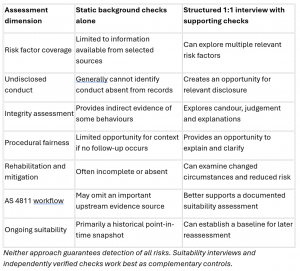
7. Comparison: Background Checks Versus Structured Suitability Interviews
Conclusion: A Background Check Finds Information. A Suitability Interview Helps Establish Meaning.
The limitations of static workforce screening are not necessarily failures of the checks themselves.
Police history checks, identity verification, reference checks and qualification verification each serve an important purpose.
The problem arises when an organisation mistakes the completion of those checks for a complete suitability assessment.
AS 4811:2022 provides a framework for managing workforce screening as a structured, ongoing risk management activity.
The Australian Government’s Personnel Security Adjudicative Standard provides an established example of whole-of-person evaluation, while the AHRC’s guidance illustrates the need for individualised and fair decision-making.
These approaches converge on one fundamental principle: a defensible assessment requires more than the discovery of adverse records. It requires an understanding of the person, the context and the risk.
For organisations with meaningful personnel security obligations, the structured 1:1 interview is therefore not just good practice. It is a practically essential part of obtaining the evidence needed to support a credible suitability decision.
The question is no longer simply whether the candidate has passed their background checks.
It is whether the organisation has gathered enough relevant information to justify trusting that individual with the responsibilities and access their position requires.
How Cleard Life Can Help
Cleard Life Vetting Agency supports organisations with structured 1:1 suitability interviews and risk assessments aligned with AS 4811:2022 and informed by Australian Government personnel security principles.
Our approach combines direct candidate engagement, structured assessment methodologies and risk-based evaluation to help organisations move beyond transactional background checking.
Whether you operate in the Defence industry, critical infrastructure or another security-sensitive environment, we can help you strengthen the quality, consistency and defensibility of your workforce screening.
Move beyond background checks. Establish genuine workforce suitability.
Key References
- AS 4811:2022 Workforce Screening — Standards information
- Australian Government PSPF Release 2026 — Section 16
- Australian Government Personnel Security Adjudicative Standard 2026
- Department of Defence — DISP Eligibility and Suitability
- SOCI Critical Infrastructure Risk Management Program Rules
- NSW ICAC — Strengthening Employment Screening Practices
- Australian Human Rights Commission — Criminal Record Discrimination Guidelines
- AHRC — 2019–20 Complaint Statistics